DSM-5-TR Differential Dx
Unbound Medicine, IncMedical
4.454.00 Reviews
- Version
- 2.8.47
- Installs
- 100.00K
- Age Rating
- Everyone
Screenshots
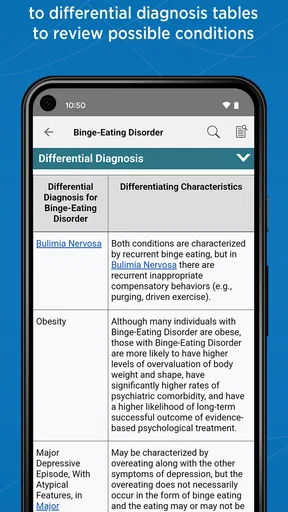
Our Review of DSM-5-TR Differential Dx
 Analysis by Appyee
I tend to reach for a diagnostic reference when a question is still taking shape: a symptom has several plausible explanations, a student is trying to distinguish overlapping criteria, or a clinician wants to check a line of reasoning before discussing it with colleagues. DSM-5-TR Differential Dx is built for that kind of reference work. It is a medical app from Unbound Medicine, Inc, and its focus is helping users navigate diagnostic possibilities through the DSM-5-TR framework. I see it as a structured aid for thinking, not a substitute for interviewing a patient or exercising clinical judgment.
Starting with a question, not a label
The most useful way to approach a differential diagnosis tool is to begin with what you have actually observed, rather than deciding on a diagnosis first and looking for confirmation. In a real appointment, that might mean noting a person’s reported symptoms, their timing, and how those concerns affect daily life. In class, it could mean taking a case vignette and listing the details that distinguish one possibility from another. The app’s subject matter suits both situations, provided you treat it as a reference and keep the full context in view.
That distinction matters because diagnostic terms can sound more conclusive than the information available at the start of a conversation. A reference can help organize possibilities, but a symptom match alone does not establish a diagnosis. I would use the app to prompt better questions and check criteria, not to turn a short description into a confident conclusion.
First Impressions
I downloaded the DSM-5-TR Differential Dx app out of sheer curiosity, hoping it would shed some light on the intricate world of mental health disorders. Right off the bat, the app impressed me with its sleek and intuitive interface. It’s not just a pretty face though; it’s packed with features that make it incredibly functional for both professionals and students.
Getting Around the App
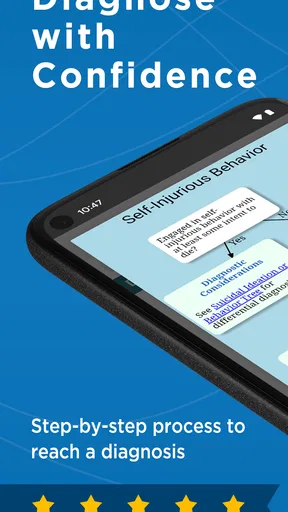
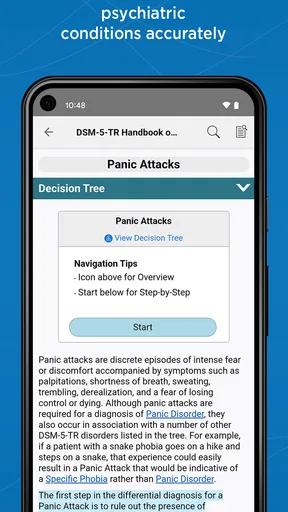
The navigation is straightforward. Once you open the app, you’re greeted with a clean dashboard that allows you to dive into different categories of disorders. You can explore by symptom, disorder, or criteria, which is super handy. The search function is also top-notch, making it easy to find exactly what you’re looking for without any hassle.
One feature I particularly loved was the ability to save searches and create custom lists. This is a lifesaver when you’re juggling multiple cases or studies. It feels like the app was designed with real-world usability in mind.
Turning a search into a careful comparison
A practical workflow is to use search or a symptom-based route to gather possible directions, then open the relevant criteria and compare them against the information you have. I would keep a short note outside the app of what is known, what is still uncertain, and what needs follow-up. That prevents an early search result from becoming an anchor: if a key detail is missing, it stays a question rather than silently turning into evidence.
Saved searches and custom lists are especially useful for teaching or ongoing study. For example, a learner can keep a list of diagnoses that are easy to confuse, then revisit the criteria side by side while studying a case. The trade-off is that a curated list reflects the questions you chose to save; it is a personal study aid, not a complete clinical record or a validated assessment.
Features That Stand Out
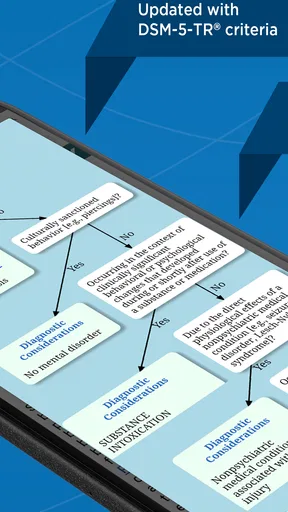
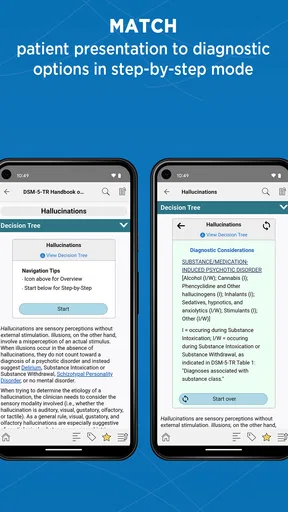
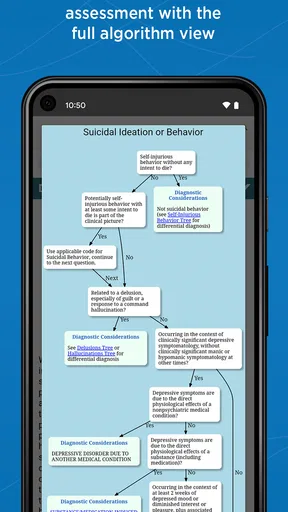
Now, let’s talk features. The app's differential diagnosis tool is a game-changer. It allows you to input symptoms and get a comprehensive list of potential diagnoses. This isn’t just a random list either; it's based on the latest DSM-5-TR criteria, ensuring you're getting up-to-date and accurate information.
Another standout feature is the detailed descriptions of each disorder. The app provides an in-depth look at symptoms, diagnostic criteria, and even treatment options. It’s like having a miniature version of the DSM with you, minus the bulk.
Putting the reference to work during a busy day
Imagine a clinician between appointments who wants to check how a symptom pattern relates to several possible diagnoses before a case discussion. A quick search can help organize the comparison, while the detailed descriptions offer a place to check the relevant criteria. The useful outcome is not an instant answer; it is a more focused conversation about what is present, what remains unclear, and what further assessment may be appropriate.
For a student, the same workflow looks different. After reading a vignette, I would first write down the evidence in the case, then use the app to compare plausible options and identify which criteria separate them. That makes it easier to explain why one diagnosis is more consistent than another, rather than memorizing a label. In either setting, the handoff matters: the app can support a discussion with a supervisor or colleague, but the person making the clinical decision still needs the broader history and context.
Learning and Development
For those new to the field, or professionals looking to brush up on their knowledge, the app includes educational resources and self-assessment quizzes. These are great for testing your knowledge and ensuring you’re staying sharp. Plus, the feedback from these quizzes is detailed, helping you learn rather than just memorize.
The app also offers regular updates, ensuring that the information remains current with any changes or additions to the DSM. This is crucial in a field where staying informed can make a significant difference in patient outcomes.
Who benefits most—and who may prefer another tool
I can see this being most useful for mental health professionals, trainees, and students who already have a reason to consult DSM-5-TR material and want a portable way to navigate it. It also suits educators who need a reference point for discussing diagnostic distinctions. Its medical focus makes it less suitable as a self-diagnosis guide for someone trying to interpret their own distress without professional support; in that situation, talking with a qualified clinician is a safer next step than matching symptoms to a list in an app.
Compared with a printed manual, a phone-based reference is easier to search and carry, and the saved-search workflow can make repeated study more convenient. Compared with general web searches, a DSM-focused reference gives the task a more consistent diagnostic frame instead of sending you across pages of uneven context. But a book or a broader clinical resource may still be preferable for someone who wants extended background, a wider range of material, or a screen-free way to study. I would choose the app for quick navigation and use other resources when the question needs more depth.
Real-World Usability
One of the things I really appreciate about the app is its real-world application. Whether you’re in a clinical setting, teaching, or studying, the app adapts to your needs. It’s like having a trusted colleague who’s always there to offer insight and support.
The app's offline capabilities are a nice touch, allowing access to information even when you're not connected to the internet. This is perfect for those on-the-go moments when you need quick access to reliable data.
Access, cost, and practical trade-offs
The app is free to install, and its preview gives users a way to experience updated content before deciding whether it fits their needs. Some in-app items cost $69.99 each, so I would check what an item includes and whether it matches my intended use before making a purchase. The preview is a sensible starting point for a student or clinician who wants to see how the material works on a phone before committing to paid content.
It has a 4.4 average from around 392 ratings, and more than 100K installs. It is rated for Everyone, though that age label should not be mistaken for advice that diagnostic material is appropriate for every reader or situation. Version 2.8.47 requires Android 9 or later. Those details make it easy to judge basic compatibility, while the more important practical question is whether a DSM-centered reference is the kind of support you actually need.
Where the workflow can break
The biggest limitation of any differential tool is the risk of treating a shortlist as a verdict. Symptoms overlap, context changes their meaning, and a person’s account may be incomplete at an initial visit. I would pause if the app’s suggestions seem to fit only because I have ignored contradictory details, or if the available information is too thin to compare criteria responsibly. In those moments, a follow-up interview, supervision, or a broader clinical resource is more valuable than another search.
There is also a practical difference between finding information and handing it into care. A saved search can help me return to a topic, but it does not replace documentation, consent-aware discussion, or the professional processes around a case. I would avoid entering identifiable patient details into any reference workflow unless I understood the relevant privacy and workplace requirements. Keeping searches general and notes securely managed elsewhere is a more cautious habit.
Readers often wonder whether this can replace the DSM itself. I would treat it as a convenient companion for navigation, not assume that a compact mobile experience covers every reason someone might consult a full reference. Another common question is whether it can diagnose a person: it can help structure consideration of diagnostic possibilities, but diagnosis requires qualified assessment and context. If you mainly want general mental-health education or support for personal distress, a clinician or a resource designed for that purpose is a better first stop.
Final Thoughts
In conclusion, the DSM-5-TR Differential Dx app is a must-have for anyone interested in or working within the mental health field. It combines comprehensive information with user-friendly features, making it an invaluable tool for both learning and practice.
Whether you’re a seasoned professional or a curious learner, this app provides the resources and support you need to navigate the complex world of mental health diagnostics with confidence. It's like having a little piece of the DSM in your pocket, ready to assist you whenever you need it.
My recommendation in context
I would recommend trying it if your work or studies regularly involve comparing DSM-5-TR criteria and you value quick lookup, saved searches, and a portable reference. I would be more cautious about recommending it to someone looking for a complete clinical system, a stand-alone diagnostic answer, or a general guide to mental wellness. The best result comes when the app helps you ask sharper questions and then hands the reasoning back to careful assessment, discussion, and professional judgment.
Verdict
Strengths of DSM-5-TR Differential Dx
- Comprehensive diagnostic criteria.
- User-friendly interface enhances usability.
- Frequent updates ensure current info.
- Cross-references for thorough analysis.
- Offline access for convenience.
Limitations of DSM-5-TR Differential Dx
- Requires subscription for full features.
- Limited customization options.
- No integration with other medical apps.
- Occasional minor bugs reported.
- Large download size.
Other Releases by Unbound Medicine, Inc
View All
Nursing Central
Medical4.8

Davis's Drug Guide
Medical4.8

Johns Hopkins Antibiotic Guide
Medical4.8

5-Minute Clinical Consult
Medical4.6
Similar Picks in This Category
View All
WebMD: Symptom Checker
WebMD, LLC4.1

Microphone Amplifier
DOSA Apps4.2

Anatomy Learning - 3D Anatomy
3D Medical OU4.5

Period Tracker and Calendar
SimpleInnovation4.9

GoodRx: Prescription Coupons
GoodRx4.8

CVS Health
CVS Pharmacy4.5
Frequently Asked Questions
What is DSM-5-TR Differential Dx and how does it work?
DSM-5-TR Differential Dx is a mobile application designed to assist mental health professionals in diagnosing psychiatric disorders. It utilizes the latest DSM-5-TR criteria to provide differential diagnosis options. Users can input symptoms, and the app suggests possible disorders, helping clinicians make informed decisions quickly.
Is DSM-5-TR Differential Dx suitable for non-professionals or students?
While DSM-5-TR Differential Dx is primarily designed for mental health professionals, it can also be a valuable educational tool for students studying psychiatry or psychology. However, it should not replace professional training or clinical judgment when diagnosing patients.
What platforms is DSM-5-TR Differential Dx available on?
The DSM-5-TR Differential Dx app is available for download on both Android and iOS devices. It is accessible through the Google Play Store and Apple App Store, making it convenient for users across different operating systems to access its features.
Does the app require an internet connection to function?
DSM-5-TR Differential Dx primarily functions offline, allowing users to access diagnostic criteria and suggestions without an internet connection. However, occasional updates or additional resources may require internet access to download the latest information and maintain accuracy.
Are there any subscription fees or in-app purchases in DSM-5-TR Differential Dx?
DSM-5-TR Differential Dx may offer a one-time purchase price or subscription model, depending on the features included. Some additional resources or advanced tools might be available through in-app purchases. It's advisable to check the app store listing for detailed pricing information.
